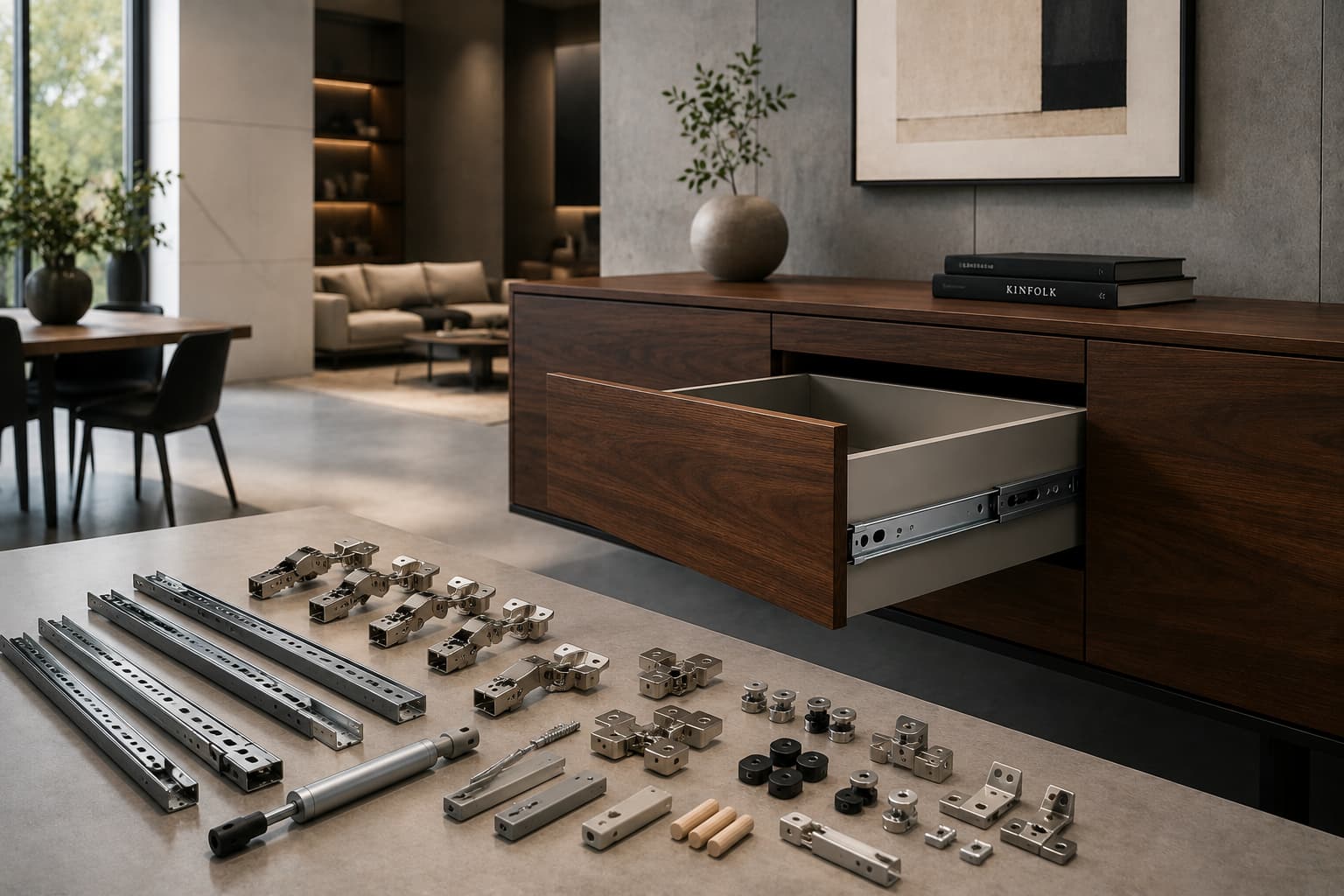

Walk into a showroom and you judge a cabinet by what you can see: the finish, the grain, the color, the handles. But ask any experienced furniture designer what actually separates a piece that lasts a lifetime from one that falls apart in three years, and they will point to the parts you never look at. Hinges, drawer slides, lift mechanisms, connectors, the humble metal fittings hidden inside every cabinet and drawer are the true foundation of furniture quality. A gorgeous cabinet with cheap hardware is a disappointment waiting to happen, while a plain one with excellent hardware will serve, silently and smoothly, for decades. Understanding this hidden layer is one of the marks that separates an amateur from a professional designer.
Consider the drawer, the single hardest-working component in most furniture. Every day it is yanked open and shoved shut, loaded with weight, and expected to glide effortlessly regardless. What makes that possible is the drawer slide, and the difference between a good one and a bad one is enormous. Cheap slides, often simple roller-based mechanisms, bind, rattle, sag under load, and refuse to pull out the last few inches, so you can never quite reach what is at the back. Quality slides, particularly the ball-bearing and concealed undermount types favored in fine cabinetry, carry a heavy drawer perfectly level, extend fully so the entire drawer is accessible, and support many times the weight without complaint. There is a simple, brutal test professionals use: load a drawer with something heavy, pull it all the way out, and let it close. A quality undermount slide carries the load level and shuts it silently. A cheap slide binds, wobbles, and teaches the whole family to lift the drawer while closing it.
Hinges tell the same story. A door hinge seems trivial until you have lived with a bad one, watching a cabinet door slowly droop out of alignment, catch on its neighbor, or slam with a bang every time. A quality concealed hinge, the type built into European frameless cabinetry, offers something a cheap one cannot: adjustability in multiple directions, so the door can be aligned perfectly even after the cabinet settles. The best are engineered to survive an astonishing number of open-and-close cycles, often tested to two hundred thousand movements or more, which is a lifetime of daily use, without loosening or failing. When a professional talks about a door that still closes perfectly after twenty years, they are really talking about the hinge.
The feature that has transformed modern furniture more than any other is the soft-close mechanism, and it is a small marvel of engineering. Integrated into a hinge or a drawer slide, a soft-close damper, usually a small piston filled with fluid, senses the closing motion and gently decelerates it over the final stretch, so the door or drawer glides shut silently instead of slamming. This is not merely a luxury. Eliminating the slam protects the whole piece of furniture from the repeated shock that loosens joints and wears out components over time. Soft-close has gone from a premium add-on to an expected standard, and it is one of the clearest examples of how a hidden mechanism directly determines both the feel and the longevity of furniture.
Beyond drawers and doors lies a whole world of specialized mechanisms that make furniture genuinely functional. Lift systems raise a cabinet door upward and hold it open overhead instead of swinging it outward, a boon for wall cabinets where a swinging door would be a hazard. Gas struts and pistons hold heavy lids and beds. Push-to-open mechanisms allow handleless, minimalist fronts that open at a touch, enabling the clean flat facades that define contemporary design. Corner-cabinet pull-out systems rescue the awkward dead space that plagues every kitchen. None of these is visible in the finished piece, yet each is the reason a clever design actually works in daily life rather than just looking good in a rendering.
There is also an invisible logic organizing all of this, a standard most people have never heard of but that quietly governs almost all modern cabinetry: the thirty-two millimeter system. Nearly all mass-produced furniture, including the flat-pack pieces in every home, is built around columns of small holes spaced exactly thirty-two millimeters apart. Into these standardized holes mount the hinges, the slides, the shelf supports, everything. This system is why furniture can be manufactured efficiently, assembled reliably, and reconfigured later. For a designer, understanding this grid is fundamental, because it is the hidden skeleton on which the hardware, and therefore the whole piece, hangs.
Because hardware matters so much, professionals learn to recognize the benchmarks of quality. A handful of engineering-driven manufacturers have become the industry’s gold standard, the names designers reach for by default when a piece must last. Their reputation rests not on marketing but on relentless engineering, precise tolerances, generous adjustability, and durability tested over hundreds of thousands of cycles. The published technical documentation of the best hardware makers is so thorough that it amounts to an education in itself. Choosing hardware from a trusted maker is one of the simplest ways to guarantee that a design will perform as promised, while the anonymous no-name kits, though better than nothing, simply cannot match built-in quality and are the wrong choice for anything meant to last.
The lesson for anyone designing or buying furniture is to look past the surface. The finish and the form are what seduce you, but the hardware is what you actually live with, every single day, for years. It is the part that determines whether a drawer glides or fights you, whether a door aligns or sags, whether the piece grows old gracefully or falls apart. The best furniture designers understand that true quality is mostly invisible, engineered into the fittings and mechanisms no one ever sees. Master that hidden layer, and everything visible finally has something solid to rest on.